Cheap Window Air Conditioners Under $100 at Walmart: What Your Budget Can Really Expect
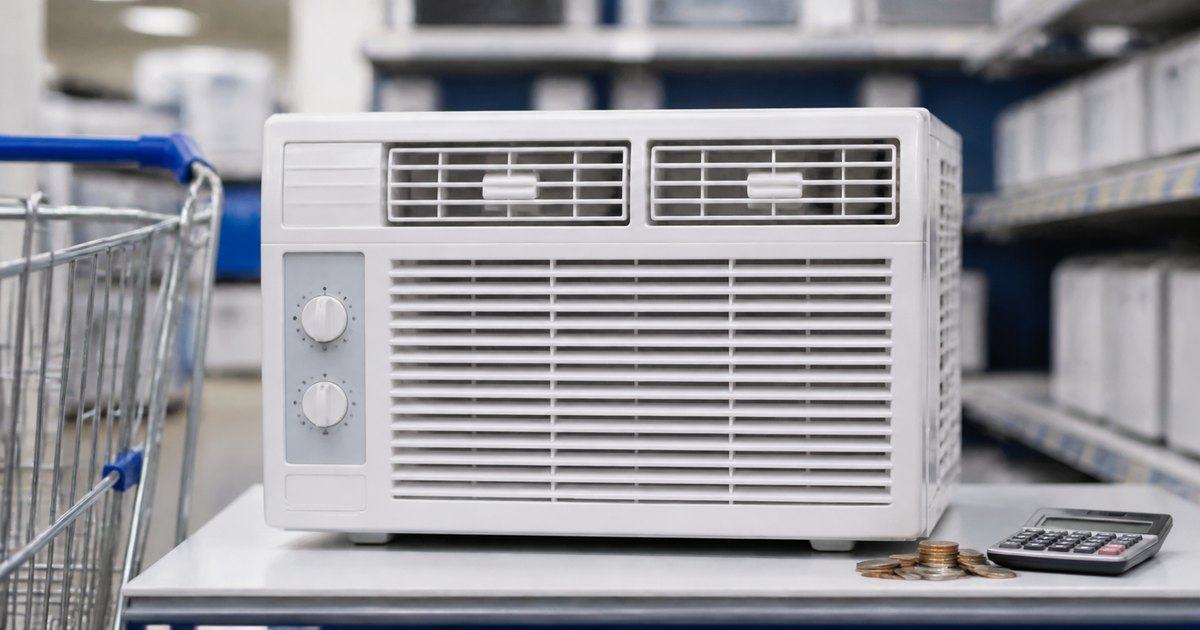
Finding cheap window air conditioners under $100 at Walmart sounds deceptively simple. You set a budget. You type the keyword. You hit search. Done.
But once you step into this price tier, you’re no longer casually browsing. You’re navigating constraints — tight margins, fluctuating availability, seasonal pricing swings, and very specific performance limitations. Under $100 is not the mainstream AC market. It’s the edge of it.
And yet, if you approach it strategically — if you understand timing, room sizing, and product categories — you can absolutely find a unit that delivers real, compressor-based cooling without draining your wallet.
Let’s break down what’s realistic, what’s marketing fluff, and how to maximize every dollar.
Can You Actually Find a Window AC Under $100 at Walmart?
Yes — but not consistently, and not without a strategy.
Most entry-level window air conditioners typically retail between $109 and $149 during peak season. However, Walmart is known for aggressive rollback pricing, especially during late summer and back-to-school periods. That’s where the sub-$100 opportunities appear. Sometimes it’s a temporary price drop. Sometimes it’s clearance inventory at specific store locations. Occasionally, it’s a refurbished or marketplace listing.
The key is understanding that under-$100 pricing is often seasonal, not permanent. You won’t see a wide selection year-round at that price point. Availability fluctuates with demand. Early June? Limited. Late August? Much better.
So yes, it’s possible—but it requires timing, flexibility, and occasionally checking local store inventory rather than relying solely on online listings.
What to Expect From a Cheap Window Air Conditioner Under $100
When your budget is capped at $100, expectations must shift accordingly.
You are not purchasing a premium inverter system. You are not getting smart connectivity or whisper-quiet operation. What you’re buying is straightforward, mechanical cooling — the essential function of an air conditioner stripped to its fundamentals.
Most units in this range are designed for small spaces and light-duty use. They prioritize affordability over advanced engineering. The housing materials may feel lighter. The controls are typically manual dials. Feature sets are minimal. But the cooling mechanism itself — a compressor-driven refrigeration cycle — remains legitimate and effective.
That’s important.
Despite budget constraints, these are still real window AC units. They don’t rely on evaporative cooling tricks or gimmicks. They pull warm air, compress refrigerant, and push cold air back into the room. Simple. Reliable. Functional.
Cooling Capacity: 5,000 BTU (Typically)
If you’re shopping for a window air conditioner under $100 at Walmart, you’re almost certainly looking at a 5,000 BTU unit. This is the standard entry-level size across major manufacturers.
A 5,000 BTU air conditioner is engineered for small rooms — roughly 100 to 150 square feet. That typically translates to a small bedroom, a dorm room, a home office, or a compact studio corner. Within those parameters, performance is surprisingly adequate. It won’t freeze the room instantly, but it will steadily lower the temperature and keep you comfortable.
The problem arises when buyers try to stretch their capacity. A 5,000 BTU unit cannot efficiently cool a large living room or open-plan apartment. When overloaded, it runs constantly, consumes more electricity, and struggles to achieve set temperatures.
Match the BTU to the room. Do that correctly, and even a sub-$100 unit can perform impressively.
Basic Controls — No Smart Features
At this price point, innovation takes a back seat to practicality.
Most cheap window air conditioners under $100 feature mechanical rotary dials for temperature and fan speed. You’ll usually get two cooling settings and one or two fan-only modes. That’s it. No digital display. No programmable timer. No Wi-Fi. No remote control in many cases.
But simplicity has advantages.
Mechanical controls tend to be durable and less prone to electronic failure. There are fewer components to malfunction. No circuit boards to fry during voltage fluctuations. No app connectivity issues. Just turn the dial and let it run.
It’s old-school cooling — direct, tactile, uncomplicated.
If you’re someone who values function over bells and whistles, this stripped-down interface may actually be a benefit rather than a drawback.
Energy Efficiency: Modest but Manageable
Budget window AC units are rarely energy-efficiency champions. They typically use standard compressor technology rather than inverter-driven systems that dynamically modulate power usage.
That means they cycle on and off to maintain temperature rather than running at variable speeds. While this approach isn’t cutting-edge, it’s functional and widely used in entry-level models.
A 5,000 BTU unit usually consumes between 400 and 500 watts per hour. For small-room usage — say, 6 to 8 hours per day — the monthly energy cost remains relatively modest. In many regions, that translates to roughly $20–$40 per month, depending on electricity rates.
Is it the most efficient solution available? No. But for temporary cooling, small spaces, or budget-conscious households, the operational costs remain manageable.
Popular Types of Window Air Conditioners Under $100 at Walmart
The sub-$100 category isn’t diverse, but it isn’t empty either.
You’ll primarily encounter entry-level 5,000 BTU mechanical models. Occasionally, Walmart-exclusive brands — such as Arctic King — dominate this tier due to competitive pricing agreements. Major brands like Frigidaire, GE, Midea, and TCL sometimes dip into this range during rollbacks.
The construction is typically compact and lightweight, making installation easier for renters and students. Adjustable side panels help seal window gaps, and most units include washable air filters for basic air quality maintenance.
The inventory changes quickly. One week, there may be five qualifying models. The next week, only one remains under budget. Monitoring availability becomes part of the strategy.
Refurbished or Open-Box Units
If you’re strictly committed to staying under $100, refurbished models open up new possibilities.
Refurbished units are typically returned products that have been inspected, repaired if necessary, and resold at discounted pricing. At Walmart, these may appear through marketplace sellers rather than directly from the retailer.
The advantage? You might secure a 6,000 BTU model or a digital control unit for under $100. That represents a performance upgrade without exceeding your budget.
The trade-off, of course, is warranty coverage. Refurbished units often carry shorter warranties, and quantities are limited. Still, for savvy shoppers willing to accept minor risk, the value proposition can be compelling.
Clearance & Rollback Deals
Seasonality drives this market.
During peak heat waves, prices rise. Demand spikes. Inventory tightens. But once late summer approaches — especially after back-to-school season — retailers begin clearing excess stock.
This is when under-$100 deals become far more common.
Labor Day sales, end-of-season markdowns, and in-store clearance tags can slash prices significantly. Sometimes, individual stores mark down units to clear floor space, creating hyper-local deals not reflected online.
If you’re patient and flexible, waiting for these windows can save $20–$40 — a substantial percentage at this price tier.
What Room Size Can a $100 Window AC Actually Handle?
Room size is everything.
A 5,000 BTU window air conditioner performs best in enclosed spaces up to 150 square feet. That’s roughly a 10×12 bedroom or a compact office. High ceilings, poor insulation, or excessive sun exposure can reduce effectiveness.
If your room has large windows facing direct sunlight, you may need to compensate with blackout curtains or reflective window film. Otherwise, the AC will struggle.
Attempting to cool 250 square feet with a 5,000 BTU unit leads to constant compressor cycling and inadequate temperature control. It’s not that the unit is defective — it’s simply undersized.
Proper sizing transforms a “cheap” unit into a surprisingly effective cooling solution.
How to Find Cheap Window Air Conditioners Under $100 at Walmart (Strategically)
Don’t just type the keyword and scroll randomly.
Start by applying the price filter to cap results at $100. Then sort by customer rating. Look for models with at least four stars and a substantial review count. Reviews often reveal noise levels, installation challenges, and long-term reliability patterns.
Next, check both shipping and store pickup options. Sometimes local inventory offers clearance pricing not visible nationally.
Finally, search using terms like “rollback” or “clearance” directly within Walmart’s site search. These tags often reveal temporary pricing that standard browsing might miss.
Strategic filtering saves time — and money.
Pros of Buying a Cheap Window Air Conditioner Under $100
Affordability is the obvious benefit. For under $100, you get genuine compressor-driven cooling. That’s remarkable compared to portable evaporative coolers, which often cost about the same but deliver comparable performance.
Installation is generally simple. These units plug into standard 115V outlets and require no professional setup. For renters, that convenience matters.
They’re also ideal for temporary use. Whether you need short-term relief during a heatwave or supplemental cooling for a single room, the financial commitment is minimal. You’re not locking yourself into a multi-hundred-dollar investment.
For budget-conscious households, that flexibility is powerful.
Cons to Consider
Lower price points come with trade-offs.
Noise levels tend to be higher in mechanical compressor units compared to modern inverter systems. The hum of the compressor and fan can be noticeable, especially in quiet nighttime environments.
Feature sets are minimal. You likely won’t have programmable timers or advanced eco modes. Temperature control precision may be less exact.
Durability can vary between brands. While many units perform reliably for years, the materials and internal components are often less robust than those of premium models.
Still, for many buyers, these limitations are acceptable given the price.
Are “Air Conditioners Under $100” Sometimes Misleading?
Absolutely.
Some listings may appear to advertise air conditioners under $100 but are actually evaporative air coolers or personal desktop cooling devices. These products do not use compressors and cannot significantly reduce room temperature in humid climates.
A legitimate window air conditioner will always list a BTU rating and specify compressor-based cooling.
If the listing emphasizes water tanks or “mini personal cooling,” it’s likely not a true AC unit.
Always confirm specifications before purchasing.
When Is the Best Time to Buy?
Timing influences pricing dramatically.
Late July through September is prime clearance season. Retailers begin preparing for fall inventory, and remaining AC units often receive markdowns.
Shopping during the first major heatwave of summer is the worst time. Demand surges, and prices follow.
If possible, buy before peak season begins or after it winds down. Planning ahead turns budget shopping into strategic shopping.
Is It Better to Spend Slightly More?
If your budget allows even a small stretch — say $120 to $150 — you may unlock higher BTU ratings or digital controls.
The difference between 5,000 and 6,000 BTU can be meaningful for slightly larger rooms. Digital thermostats provide more precise temperature regulation.
However, if your room is small and your budget is firm, a sub-$100 model remains a viable, practical option.
FAQs
Can I really find a window AC under $100 at Walmart?
Yes — typically 5,000 BTU mechanical units during rollbacks, clearance sales, or late-season discounts.
What room size can a sub-$100 AC cool?
Usually 100–150 square feet. Think small bedrooms, dorm rooms, or compact offices.
Are these units energy efficient?
They’re moderately efficient. Not inverter-level savings, but manageable for small-space use.
Do they come with remotes or smart features?
Most do not. Expect manual dials and basic controls at this price point.
Are refurbished models worth it?
They can be — especially if you want slightly higher BTU capacity under $100. Just check the warranty terms.
When is the best time to buy?
Late summer and early fall, when clearance pricing is common.
Comparison Table: What to Expect Under $100
|
Feature |
Typical Under $100 Window AC |
What It Means for You |
|
BTU Capacity |
5,000 BTU |
Ideal for 100–150 sq ft rooms |
|
Controls |
Manual dials |
Simple operation, fewer electronic issues |
|
Energy Use |
400–500 watts/hr |
Affordable monthly operating cost |
|
Noise Level |
Moderate |
Noticeable hum, especially at night |
|
Smart Features |
Rare/None |
No Wi-Fi or app control |
|
Installation |
Standard 115V outlet |
Easy DIY setup |
|
Best Buying Season |
Late summer clearance |
Higher chance of sub-$100 pricing |
|
Ideal For |
Dorms, renters, small bedrooms |
Budget-focused cooling solution |
Conclusion
A cheap window air conditioner under $100 at Walmart is not a fantasy — but it’s not a luxury product either.
It’s utilitarian. Focused. Direct.
If you size it correctly, buy strategically, and install it properly, it can deliver genuine relief during sweltering months without straining your budget.
It won’t be silent. It won’t be smart. It won’t feel premium.
But when the temperature climbs, and cold air starts flowing into your room, none of that matters.
Sometimes, simplicity executed well is more than enough.