How To Clean Window Air Conditioner (Step-By-Step Guide for Maximum Efficiency and Fresh Air)
A window air conditioner works harder than most people realize.
Day after day, it inhales the invisible. Dust motes drifting through afternoon light. Microscopic pollen is carried in on a breeze. Pet dander. Urban grime. Humidity is thick enough to cling to the coils. It doesn’t complain. It just keeps pulling, cooling, cycling.
Until it can’t.
Performance drops subtly at first. The airflow feels less assertive. The room takes longer to cool. A faint odor appears — something damp, something stale. And slowly, energy consumption creeps upward while comfort declines.
Most homeowners don’t notice the shift immediately. But the system does.
If you’ve searched “How to clean a window air conditioner”, you’re likely at that turning point — when maintenance shifts from optional to necessary. The good news? Cleaning a window AC unit is neither complicated nor expensive. What it requires is precision, patience, and a methodical approach.
This guide walks you through exactly how to restore your unit’s efficiency, improve indoor air quality, and extend its lifespan — safely, thoroughly, and intelligently.
Why Cleaning Your Window Air Conditioner Matters
Cleaning isn’t cosmetic. It’s mechanical.
A window air conditioner functions through heat exchange. Air passes across evaporator coils, heat is absorbed, and cooled air is redistributed into the room. When those coils are coated in dust, airflow weakens. When the filter is clogged, circulation suffers. When moisture mixes with debris, mold can form.
The result? Reduced cooling efficiency and elevated strain on the compressor — the most expensive component of the unit.
And strain compounds over time.
A neglected system doesn’t fail suddenly. It deteriorates gradually. It draws more electricity to compensate. It runs longer cycles. It works harder to achieve the same result.
Cleaning interrupts that decline.
It restores airflow.
It reduces operational stress.
It improves air quality.
It lowers energy consumption.
And perhaps most importantly, it protects your investment.
A properly maintained window AC unit can last 8–12 years. One that’s neglected? Significantly less.
Maintenance isn’t an inconvenience. It’s preservation.
How Frequently Should a Window Air Conditioner Be Cleaned?
The frequency depends on environment, usage, and exposure.
If your window air conditioner runs daily during summer — particularly in humid or dusty climates — monthly filter maintenance becomes essential. That doesn’t mean a full teardown every month. But it does mean removing and rinsing the filter to prevent buildup from hardening into stubborn residue.
For moderate users, cleaning every 2–3 months is typically sufficient. However, environmental factors complicate that guideline.
Do you live near construction zones?
Do you have shedding pets?
Are there trees shedding pollen near your window?
These variables accelerate debris accumulation.
Seasonal transitions are also critical checkpoints. Clean before heavy summer use begins. Clean again before storing for winter. If the unit sits dormant without cleaning, trapped moisture can foster mildew growth during storage.
Consistency matters more than intensity.
Frequent light maintenance prevents the need for aggressive deep cleaning later — and dramatically reduces the risk of performance degradation during peak heat.
Tools and Supplies You’ll Need
Preparation determines efficiency.
Cleaning a window air conditioner doesn’t require specialized HVAC equipment, but using appropriate tools ensures safety and prevents accidental damage.
At minimum, gather:
- Phillips screwdriver
- Vacuum with soft brush attachment
- Soft-bristled brush
- Mild dish soap
- Warm water
- Spray bottle
- Microfiber cloths
- Gloves
For deeper cleaning, add:
- Commercial no-rinse coil cleaner
- Fin comb (for straightening bent aluminum fins)
- Compressed air canister
Avoid harsh chemicals, such as bleach, and abrasive scrubbing pads. These can corrode metal surfaces and damage delicate components.
Also consider workspace setup. Place a towel beneath the unit to catch debris. Keep screws organized. Ensure good lighting so you can see the interior of the housing clearly.
Preparation reduces frustration. It also prevents rushed mistakes — the kind that bend fins, damage wiring, or crack plastic panels.
Take five minutes to gather supplies. It will save you $30 on cleaning.
Turn Off and Unplug the Unit
Electricity and water do not coexist safely.
Even if the unit is switched off, internal components remain connected to power until unplugged. Capacitors in the system can temporarily retain charge. While window AC units are relatively safe compared to central HVAC systems, they still pose a risk.
Unplug the unit completely from the wall outlet. If accessible, turn off the breaker supplying that outlet as an added precaution.
Pause.
Allow the system to sit for several minutes before proceeding. This ensures any residual electrical charge dissipates.
Safety during maintenance isn’t dramatic — it’s procedural. It’s the quiet discipline of disconnecting power before touching internal components.
Never assume safety. Confirm it.
Only after complete disconnection should you remove panels or expose internal parts.
This step takes less than ten seconds. It protects you from far greater consequences.
Remove the Front Panel
The front grille serves as the first barrier between airborne debris and the internal system. Over time, it accumulates dust — sometimes visibly, sometimes invisibly.
Most window AC units use either snap clips or small screws to secure the panel. Consult your manufacturer’s manual if unsure. Apply gentle pressure; forcing it can crack the plastic housing.
Once removed, inspect the backside of the grille. Dust accumulation often collects in corners and vent slats where airflow slows.
Use a gentle towel and warm, soapy water to clean each one separately. Before reinstalling, give it a thorough rinse and let it air dry fully.
Behind the panel sits the air filter — the most critical maintenance point in the entire unit.
Removing the front panel grants access not only to clean surfaces but also to the heart of airflow management.
Proceed deliberately. Plastic components can become brittle with age.
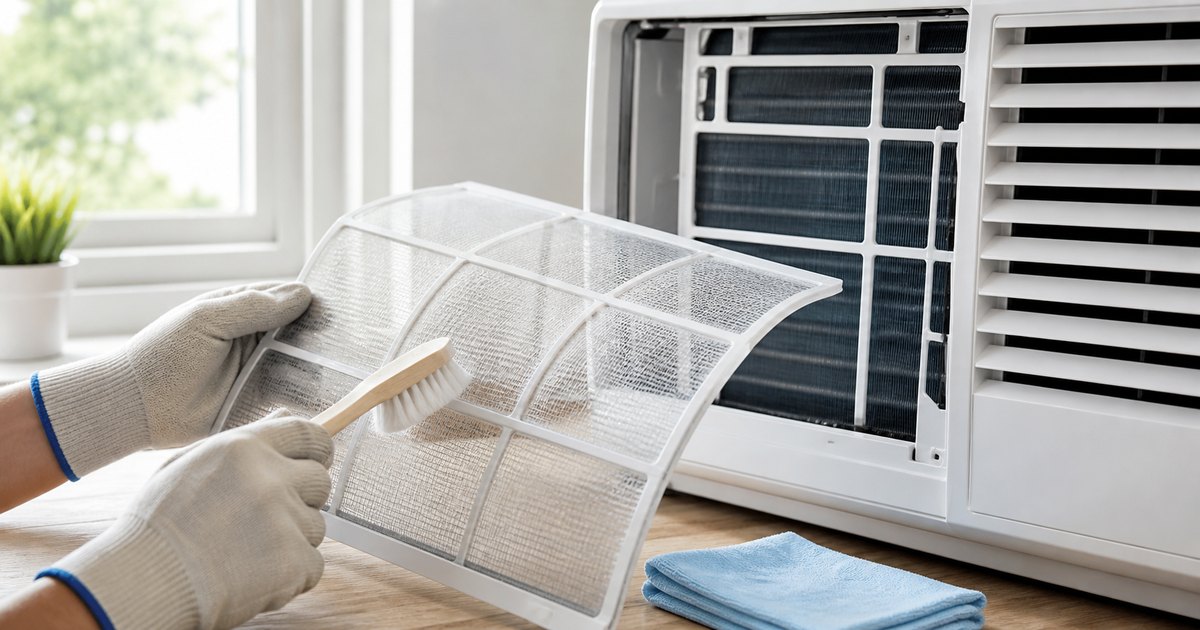
Clean the Air Filter
The air filter is the gatekeeper.
It traps airborne particles before they reach the evaporator coils. When clean, it allows unrestricted airflow. When clogged, it suffocates circulation and forces the unit to compensate.
Remove the filter carefully. Inspect it against the light. If light barely passes through, it’s overdue for cleaning.
Begin by vacuuming loose debris using a soft brush attachment. This prevents mud-like residue during washing.
Next, wash it in warm water mixed with mild dish soap. Gently agitate to loosen embedded dust. Avoid scrubbing aggressively; mesh material can tear.
Rinse thoroughly.
Then wait.
Allow the filter to dry fully — preferably in open air. Reinstalling a damp filter traps moisture inside the unit, inviting mold growth.
If the filter appears warped, brittle, or damaged, replace it. Filters are inexpensive, and a fresh one dramatically improves performance.
This step alone often restores noticeable airflow.
Vacuum the Interior
With the filter removed, interior components become visible.
Use a vacuum with a soft-bristle attachment to remove loose debris from the unit housing. Focus on corners, ledges, and visible dust clusters.
Be gentle.
Internal wiring, insulation, and coil fins are delicate. Avoid pressing firmly against components.
Dust accumulation inside the housing reduces heat insulation, reducing cooling efficiency. Even thin layers can interfere with optimal operation.
Pay special attention to:
- The evaporator coil face
- Blower wheel area
- Drain pan edges
Slow, deliberate movements prevent accidental damage.
This stage isn’t about perfection. It’s about removing the bulk of debris before applying deeper cleaning measures.
Vacuuming first reduces the risk of spreading dust when moisture is later introduced.
Clean the Evaporator Coils
The evaporator coils perform the essential task of absorbing heat from indoor air.
When coated in grime, they lose efficiency.
Using a soft brush, gently loosen surface dust. Always brush in the direction of the fins — never across them.
For more thorough cleaning, apply a no-rinse coil cleaner designed for residential AC units. Spray lightly and allow the foam to penetrate the buildup. These cleaners are designed to safely dissolve residue without rinsing.
If fins appear bent, use a fin comb to realign them. Proper spacing ensures unrestricted airflow.
Never use sharp objects to scrape coils. Aluminum fins are thin and easily damaged.
Coil cleanliness directly affects cooling performance. Even minor buildup reduces heat exchange efficiency.
Take your time here. This step restores the core function of your window air conditioner.
Clean the Drainage System
Air conditioners remove humidity, and humidity produces water.
That water drains through a designated channel or hole. If clogged, water accumulates inside the unit, leading to leaks, corrosion, or mold.
Inspect the drain hole carefully. Use a thin brush, pipe cleaner, or compressed air to clear obstructions.
Check the drain pan for standing water. Wipe it clean with a damp cloth.
Persistent moisture inside the system creates the musty smell many people associate with “dirty AC.” Often, the culprit is simply blocked drainage.
Ensuring free-flowing drainage protects both the unit and your indoor air quality.
Moisture management is just as important as dust removal.
Clean the Exterior and Rear Coils
The exterior portion of the unit faces the elements — rain, dust, leaves, and pollution.
Inspect the rear coils for debris. Gently vacuum loose particles. If necessary, use coil cleaner lightly.
Never use high-pressure water. It can flatten fins and force water into electrical compartments.
If removing the unit for seasonal deep cleaning, ensure it’s supported safely. Window units are heavy and awkward.
Exterior maintenance improves airflow and prevents overheating during peak operation.
Remember: cooling efficiency depends on heat release to the outside just as much as on heat absorption inside.
Wipe Down and Reassemble
Cleaning is incomplete until surfaces are wiped and components are reassembled correctly.
Wipe the controls, housing, and front panel with a moist microfiber cloth.
Ensure every component is completely dry before reinstallation.
Reassemble carefully. Tighten screws firmly but not excessively.
Plug the unit back in. Power it on.
You should feel stronger airflow. Possibly cleaner-smelling air.
Sometimes, maintenance rewards you immediately.
Window Air Conditioner Cleaning Guide (Quick Reference Table)
|
Component |
How to Clean It |
Recommended Frequency |
Why It Matters |
Difficulty Level |
|
Air Filter |
Remove, vacuum loose dust, wash with warm soapy water, air dry completely |
Every 30 days during heavy use |
Restores airflow, improves air quality, reduces strain on unit |
Easy |
|
Front Grille / Panel |
Wipe with damp cloth or wash with mild soap and water |
Every 1–2 months |
Prevents dust recirculation and improves appearance |
Easy |
|
Evaporator Coils |
Gently brush debris, apply no-rinse coil cleaner if needed |
Once per season |
Improves cooling efficiency and heat absorption |
Moderate |
|
Coil Fins |
Straighten carefully using fin comb if bent |
As needed |
Maintains proper airflow and prevents overheating |
Moderate |
|
Interior Housing |
Vacuum with brush attachment, wipe accessible areas |
Every 2–3 months |
Removes dust buildup that restricts internal airflow |
Easy |
|
Drain Hole / Drain Pan |
Clear clogs using pipe cleaner or compressed air |
Once per season |
Prevents leaks, mold growth, and musty odors |
Easy |
|
Rear / Exterior Coils |
Vacuum debris, lightly spray with coil cleaner if needed |
Once per season |
Ensures proper heat release and system efficiency |
Moderate |
|
Full Deep Clean (Unit Removed) |
Remove casing, clean fan blades and internal components |
Once per year |
Extends lifespan and restores peak performance |
Advanced |
FAQs
How often should I clean my window air conditioner?
Clean the air filter every 30 days during heavy use. Deep-clean coils and interior components at least once per season to maintain efficiency and airflow.
Can I spray water inside my window AC unit?
Yes, but only during a deep clean and while the unit is completely unplugged. Use low-pressure water and avoid electrical components. Never use a pressure washer.
Why is there a musty smell coming from my window air conditioner?
A musty smell usually indicates mold or mildew buildup from trapped moisture or a clogged drain system. Cleaning the filter, coils, and drain pan typically resolves the issue.
Do I need to remove the AC from the window to clean it?
Not for basic cleaning. You can clean the filter, coils, and interior without removing the unit. Full removal is only necessary for deep seasonal cleaning.
What happens if I don’t clean my window air conditioner?
Dust buildup restricts airflow, reduces cooling efficiency, increases energy bills, and can strain the compressor — potentially shortening the unit’s lifespan.
Can a dirty window AC cause higher electricity bills?
Yes. When airflow is blocked, the unit works harder and runs longer cycles, consuming more energy to achieve the same cooling level.
How do I know if my window AC needs cleaning?
Signs include weak airflow, unusual odors, visible dust, ice on coils, and rising energy costs. Any of these indicates restricted airflow or internal buildup.
Conclusion
Cleaning a window air conditioner isn’t complicated. But it is transformative.
It restores performance.
It lowers strain.
It improves air quality.
It reduces energy costs.
More importantly, it extends the life of a system designed to keep you comfortable through intense summer heat.
Maintenance is quiet work. It rarely feels urgent — until discomfort arrives.
Stay ahead of it.
A clean air conditioner doesn’t just cool better; it also runs more efficiently. It works smarter. And in the height of summer, that difference matters more than most people expect.
Leave a Reply